Each year, the BCV Sustainability Award recognises the Strategic Consulting Project (SCP) from the HEC Lausanne Executive MBA that demonstrates the strongest positive impact on sustainability. Awarded to a participant of the EMBA Class of 2025, this distinction highlights how executive learning can translate into meaningful, long-term impact beyond the classroom.
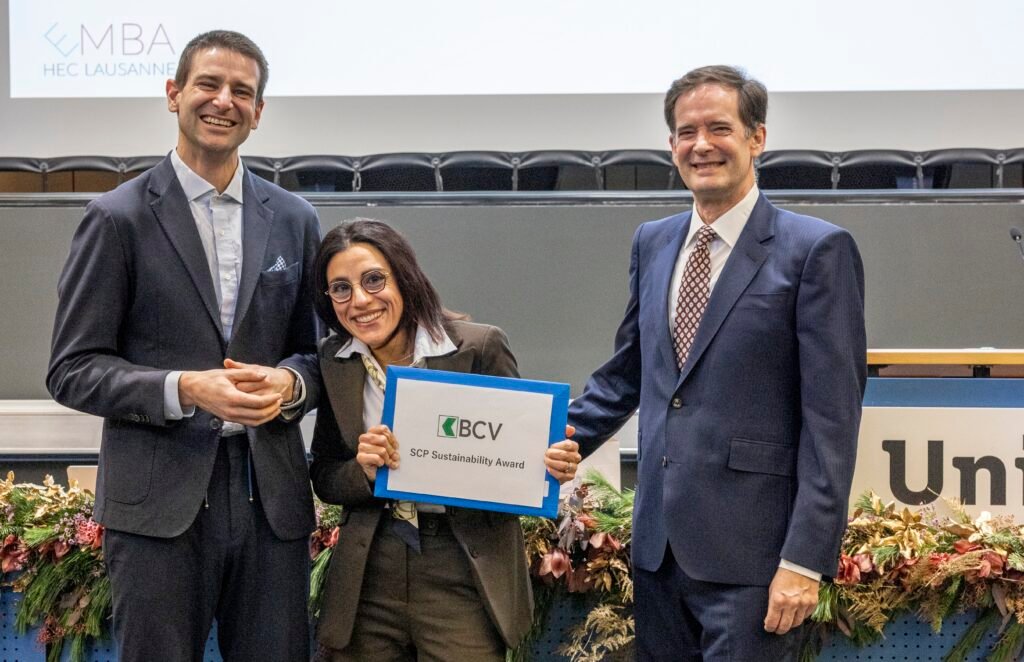
This year’s award was presented to Giannina Iannotti, HUG-NeuroCenter Manager & Operations Lead, for her Strategic Consulting Project developed within the HEC Lausanne Executive MBA and its Healthcare Management Focus. Her work proposes a sustainable, health-economics-informed approach to the management of mild and moderate traumatic brain injury, addressing a major public health challenge.

The SCP is an individual project that should address a strategic question within an existing organisation or a new venture. In a few words, what was your Strategic Consulting Project about, and what key problem were you aiming to address?
Mild and moderate traumatic brain injuries (TBI) represent around 80% of all TBI cases worldwide. Despite their high socioeconomic impact, including substantial healthcare and productivity costs, these injuries are often misdiagnosed, underestimated, or not managed in a timely manner.
To address this gap in the Geneva area, HUG launched in Nov. ‘24 a one-year pilot outpatient consultation for mild and moderate TBI at Campus Biotech. The objective of my Strategic Consulting Project was to identify a sustainable, long-term model for this outpatient service, leveraging the research-oriented environment of Campus Biotech to create a stronger value proposition that integrates clinical care, research, and prevention.
The goal of this capstone project is to provide participants with an opportunity to apply what they are learning along the curriculum to their profession. What EMBA learning/tools were you able to put into practice?
To achieve sustainability for the outpatient consultation, the project combined two parallel approaches. An evidence-based analysis was used to quantify real patient demand, assess supply constraints, and evaluate the economic potential for HUG, relying on hospital clinical and financial data.
This was complemented by strategic management tools to structure and validate the value proposition. I applied frameworks from the Strategic Management course (SWOT, PESTEL, VRIO, benchmarking) to assess market positioning and value creation, and translated the strategy into measurable KPIs and a Balanced Scorecard for monitoring and long-term planning up to 2030.
From a Health Economics and Financial Fundamentals perspective, I applied break-even and demand–supply analyses to evaluate financial sustainability. In parallel, concepts from Negotiation supported stakeholder alignment and institutional integration within HUG.
By acting as a consultant, the SCP invites participants to step back from their day-to-day work and adopt a strategic perspective. What new perspective did this process bring to your work?
Throughout the EMBA courses, I constantly asked myself what additional perspective or tool each course could bring to my SCP, and how it could strengthen or challenge my initial assumptions.
This exercise gradually shifted my focus from operational problem-solving to a broader, systemic view of the outpatient consultation, considering not only clinical needs but also strategy, economics, governance, and long-term impact. It helped me frame the problem at a higher level, identify what truly drives sustainability, and connect individual decisions to an overall strategic narrative.
The SCP aims to create value beyond academic learning. What impact has your project had so far, or do you expect it to have on your field or institution?
The impact of the SCP started to emerge already during the course of the project. As the work progressed, the outpatient consultation for mild and moderate TBI gained clearer institutional recognition and was formally integrated into the HUG organigram as part of the NeuroCentre, where I serve as Chief of Operations.
At governance level, a major outcome of the project was that the work conducted laid the foundations for the official validation of the mild and moderate TBI pathway within the DéCLIC programme, one of HUG’s highly selective coordinated care itineraries. This step enabled structured collaboration with Emergency Departments—the main entry point for TBI patients—and supported the development of a coordinated and digitalised follow-up from emergency admission to outpatient care at Campus Biotech.
Beyond institutional structuring, the project also generated concrete developments in research and prevention. The TRAUMA SPORT project was launched in collaboration with the Association Genevoise des Sports (AGS) to raise awareness and improve the management of mild and moderate TBI across sports at all levels.
In parallel, a collaboration with EPFL, Threestones Foundation, enabled a geospatial analysis of more than a decade of severe TBI cases to identify high-risk areas in Geneva and inform prevention strategies for seniors, with a scientific article in submission.
Finally, the SCP contributed to strengthening institutional visibility and strategic alignment through the organisation of a TBI awareness event in collaboration with HUG’s General Director during the World Hospital Congress (November 2025). This initiative positioned mild and moderate TBI as a governance-level topic and opened the way for concrete collaborative actions that are being developed in the current year.
Beyond its impact on your field, how did your SCP and the Executive MBA experience influence you as a leader and scientist?
Looking at what has been achieved during the first year, it is clear that the SCP was a collective project, where bringing the different pieces together was essential to move forward. In this context, my role was to ensure coordination, alignment, and continuity across the team —an exercise in leadership that was directly supported by the EMBA courses and by the ongoing exchanges with my classmates.
Through this process, the EMBA helped me develop a stronger sense of legitimacy and authenticity as a leader. I learned to step back from purely individual interpretations of problems, recognise both areas for improvement and existing strengths, and use them to motivate others toward a shared objective.
As a scientist, the programme significantly complemented my academic background by providing new analytical frameworks, language, and decision-making tools that were not part of my scientific training. The SCP itself reflects this evolution: combining a rigorous evidence-based approach with strategic and financial reasoning.
Overall, the EMBA equipped me with a broader and more structured way of thinking, enabling me to operate more confidently at the interface between science, strategy, and leadership, and to continue developing in this direction.